Iran war: Geopolitics and Economic Security
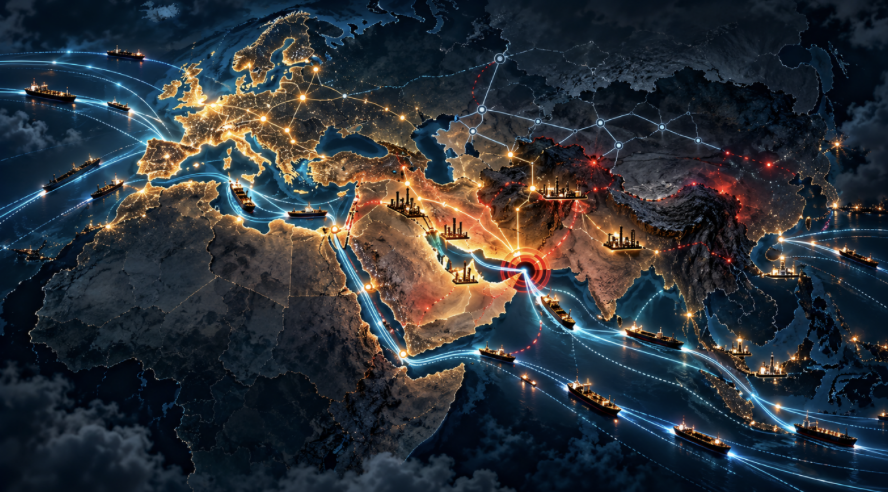
Trump’s war launched against Iran on the 28th of February has devolved into a humiliating struggle which has exposed the limits of American power. The Iranians have severely disrupted shipping through the Strait of Hormuz, through which 20 percent of the world’s oil previously flowed as well as many other goods. According to the IEA's 14 October report, approximately 10.9 million barrels per day passed through Hormuz in September, compared with around 20 million before the war. That represents roughly 55% of the original flow. Meanwhile, total Gulf crude exports, including alternative routes, had recovered to more than 75% of pre-war levels. Renewed attacks have subsequently threatened this recovery.
What I find most striking about the Iran war is not simply its disruption of global markets, but what it reveals about the changing nature of international power. The apparent limits of American deterrence raise a more fundamental question: can the economic interdependence that has defined globalisation remain secure in an increasingly multipolar world?
This is because, for the past 35 years, America’s status as a sole superpower has underpinned the smooth operation of global markets. American naval dominance, particularly its ability to secure strategically important maritime trade routes, helped create an international environment in which countries could pursue economic specialisation without independently guaranteeing the security of their supply chains. The American military presence in the Persian Gulf, for instance, has historically helped protect the international oil trade against regional threats. However, American dominance was not merely military. As the world's leading economic power, the United States possessed considerable leverage in shaping international trade rules and encouraging economic liberalisation. Its influence helped sustain a relatively predictable international trading environment in which countries could prioritise economic efficiency and access to cheaper foreign resources, often at the expense of maintaining their own productive capabilities and strategic independence. As the world becomes increasingly multipolar, however, this system faces growing challenges, with countries increasingly willing to employ tariffs, sanctions and export restrictions in pursuit of their geopolitical interests. Consequently, the security of international trade is threatened not only by military disruption but also by the growing use of economic relationships as instruments of political power.
This status as a sole superpower was embodied in the concept of the pariah state, like Afghanistan, North Korea, and Iran. This is increasingly a questionable concept, as these states are not really pariahs but increasingly important to the global balance of power.
Where I think this vulnerability is most pronounced is in Europe, historically the crown jewel of human achievement. Having lost their empires, in an increasingly multipolar world order, they are perhaps the most vulnerable countries, poor in raw resources as they are. This wasn’t so much an issue during the Cold War, which was perhaps a more predictable order than our current one, with two major power blocs which behaved somewhat predictably. At the same time, during the Cold War, the Americans had a much more direct interest in European protection. However, with somewhat erratic American behaviour, it has become increasingly unclear where Europe stands.
Despite its considerable industrial and financial wealth, the European Union remains heavily dependent on foreign resources, importing 57% of its energy requirements in 2024, according to Eurostat. This dependence extends beyond energy: the European Commission has identified China as the source of 97% of the EU's magnesium supply and the dominant processor of rare earth elements essential to advanced manufacturing and defence. The consequences of this dependence have become increasingly apparent during the Iran war, with the European Central Bank's June 2026 projections revising economic growth downwards and forecasting inflation to reach 3.4% in the latter half of the year, largely as a consequence of rising energy prices. Having already experienced the vulnerabilities associated with Russian energy dependence following the invasion of Ukraine, Europe now faces another demonstration of how geopolitical events beyond its control can undermine economic stability. For a continent whose prosperity has long rested upon international trade, the ability to secure essential resources may increasingly prove as important as the ability to purchase them.
For Europe, this presents a particular dilemma. Historically reliant on American security guarantees and international commerce, European states must now confront the possibility that their economic prosperity and strategic security may not always be guaranteed by the same relationships. Crucially, however, European states are not equally vulnerable to geopolitical insecurity. Those with greater independent military capabilities may have more freedom to pursue strategic autonomy and maintain influence over Eurasian trade networks, while countries facing more immediate security threats may prioritise their relationships with the United States. These diverging economic and security interests could increasingly threaten the coherence of the European Union, as its members find themselves pursuing conflicting geopolitical priorities.
As Commerce students, we are accustomed to thinking about the economy in terms of prices, profits and efficiency. Yet the Iran war exposes the limitations of treating resources merely as commodities to be purchased at the lowest available price. Market prices may reflect immediate scarcity, but they do not necessarily account for the strategic dangers of dependence on foreign resources whose availability can be determined by political and military events.
This brings us to Friedrich List's nineteenth-century conception of economic nationalism. Unlike classical economists who emphasised the immediate benefits of free trade and specialisation, List argued that a nation's long-term prosperity depended upon its productive capabilities and economic independence. The Iran war has provided a contemporary illustration of this distinction. The cheapest source of energy is not necessarily the most secure, and the efficiency of international markets offers little consolation when the resources upon which an economy depends become inaccessible. This is not necessarily an argument for complete autarky, which carries considerable economic costs of its own, but rather for recognising that national security and economic efficiency are not always compatible objectives. In an increasingly uncertain geopolitical order, commerce students may need to think not only about the price of resources, but also about who controls them, how they are transported, and whether their continued availability can be guaranteed. Ultimately, economics is increasingly unable to be separated from the political power that makes markets possible.


